 史鉴
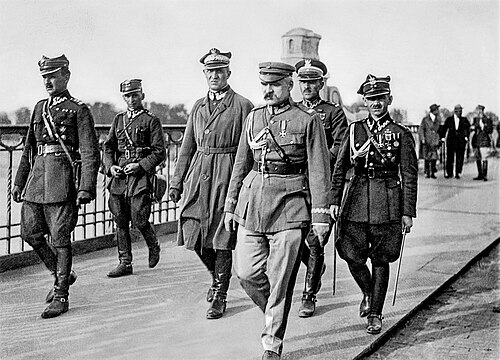
图:Marian Fuks (1884-1935) · Public domain · 维基共享资源
五月政变是由约瑟夫·毕苏斯基元帅在波兰发动的一场政变,时间为1926年5月12日至14日。这场政变推翻了当时的总统斯坦尼斯瓦夫·沃伊切霍日夫斯基及总理文岑蒂·维托斯。政变后,新政府成立,由利沃夫理工学院的卡齐米日·巴尔特教授领导。
1925年德意志魏玛共和国与法兰西签订条约,彻底舍弃波兰,隔年4月又再与俄罗斯的苏维埃政权签订条约,但这两次期间波兰代表皆未受邀出席。毕苏斯基鉴于波兰的独立稳定性面临新出现的威胁,非常时期须用非常手段,成了此次政变的部分原因。起初,毕苏斯基受到邀请担任总统,但他婉拒邀请,并转而推荐伊格纳齐·莫希奇茨基。然而,毕苏斯基仍旧是波兰政坛上最具有影响力的人物,并成为总统背后的掌权者,此一情况一直到其1935年逝世才结束。
正文摘自中文维基百科「波兰五月政变」(删去了参考文献、表格和图片),按 CC BY-SA 4.0 使用
英文维基百科的更多内容
中文维基百科这一条比较短,下面是英文维基百科同一条目的节选,原文为英文,未翻译。
The May Coup (Polish: przewrót majowy or zamach majowy) was a coup d'état carried out in Poland by Marshal Józef Piłsudski from 12 to 14 May 1926.
The attack of Piłsudski's supporters on government forces resulted in the overthrow of the democratically-elected government of President Stanisław Wojciechowski and Prime Minister Wincenty Witos and caused hundreds of fatalities.
A new government was installed, headed by Kazimierz Bartel. Ignacy Mościcki became president. Piłsudski remained the dominant politician in Poland until his death in 1935.
Background
Józef Piłsudski, who controlled politics in the reestablished Polish state to a considerable degree, had lost his advantage in the aftermath of the failed Kiev offensive of spring 1920. He retained high esteem in segments of the armed forces that originated from his earlier activities.
In November 1925, the government of Prime Minister Władysław Grabski was replaced by the government of Prime Minister Aleksander Skrzyński, which had received support from the National Democrats and the Polish Socialist Party (PPS). General Lucjan Żeligowski became the new government's minister of military affairs. After the PPS withdrew its support, this government also fell and was replaced by one headed by Prime Minister Wincenty Witos, formed by the Polish People's Party "Piast" and the Christian Union of National Unity (Chjeno-Piast). The new government, however, had even less popular support than the previous ones, and pronouncements from Piłsudski, who viewed the constant power shifts in the Sejm (Polish parliament) as chaotic and damaging, set the stage for the coup.
The coup events were also inspired by Piłsudski's perception of the need for extraordinary measures in the face of the emerging threats to the maintenance of Poland's independence.……
Coup d'état
On 10 May 1926, the coalition government of Christian Democrats and Agrarians (PSL) was formed. On the same day, Józef Piłsudski, in an interview with the newspaper Kurier Poranny ('The Morning Courier'), said that he was "ready to fight the evil" of sejmocracy (a contemptuous term for a rule by Polish parliament) and promised a "sanation" (restoration to health) of political life. The newspaper edition was confiscated by the authorities.
The night of 11–12 May, a state of alert was declared in the Warsaw military garrison, and some units marched to Rembertów, where they pledged their support to Piłsudski. On 12 May, they moved on Warsaw and captured bridges over the Vistula River. The government of Prime Minister Wincenty Witos declared a state of emergency.
At about 17:00, Piłsudski met President Stanisław Wojciechowski on the Poniatowski Bridge. Piłsudski demanded a resignation of the Witos cabinet, but the president demanded capitulation of Piłsudski's forces. No agreement was reached and fighting erupted at about 19:00 hours.
The next day, a new round of negotiations began, mediated by Archbishop Aleksander Kakowski and Marshal of the Sejm Maciej Rataj. They brought no change to the stalemate.
Consequences
Piłsudski initiated a Sanation government (1926–1939), supposedly to restore moral fitness to public life. Until his death in 1935, Piłsudski played a preponderant role in Polish politics. He formally held the offices of defence minister and Inspector general of the armed forces in all governments until his death, two of which he headed himself in 1926–1928 and 1930.
The democratic March Constitution of Poland was replaced by Piłsudski and his supporters by the April Constitution in 1935. It was tailored to Piłsudski's specifications and provided for a strong presidency, but came too late for Piłsudski to assume that office. It remained Poland's constitution until the outbreak of World War II and was recognized by the Polish government-in-exile afterwards.
正文摘自英文维基百科(原文为英文,未翻译)「May Coup (Poland)」(节选,删去了参考文献、表格和图片),按 CC BY-SA 4.0 使用;在维基百科读全文 ›
相关人物
相关政权
同时期、同地区的大事
- 犹太人大屠杀1933 年—1945 年 · 屠杀与暗杀 · 欧洲
- 大萧条1929 年 10 月 29 日—1941 年 · 时代与时期 · 欧洲
- 奥斯威辛集中营1940 年 5 月 20 日—1945 年 1 月 27 日 · 其他事件 · 欧洲
- 西班牙内战1936 年 7 月 18 日—1939 年 4 月 1 日 · 战争 · 欧洲
- 凡尔赛条约1920 年 1 月 10 日 · 条约与会议 · 欧洲
- 十月革命1917 年 10 月 25 日—1917 年 10 月 26 日 · 革命与起义 · 欧洲
- 国家社会主义德国工人党1920 年 2 月 24 日—1945 年 10 月 10 日 · 其他事件 · 欧洲
- 苏德互不侵犯条约1939 年 8 月 23 日—1941 年 6 月 22 日 · 其他事件 · 欧洲
- 党卫队1925 年 4 月 4 日—1945 年 5 月 8 日 · 其他事件 · 欧洲
- 盖世太保1933 年 4 月 26 日—1945 年 5 月 8 日 · 其他事件 · 欧洲
- 德国国旗1917 年 · 其他事件 · 欧洲
- 冬季战争1939 年 11 月 30 日—1940 年 3 月 13 日 · 战争 · 欧洲
同时期的同类事件(革命与起义)
- 1917年俄国革命1917 年 · 革命与起义 · 中亚与北亚
- 俄国二月革命1917 年 3 月 8 日—1917 年 3 月 16 日 · 革命与起义 · 欧洲
- 古巴革命1953 年 7 月 26 日—1959 年 1 月 1 日 · 革命与起义 · 拉丁美洲
- 1956年匈牙利革命1956 年 10 月 23 日—1956 年 11 月 10 日 · 革命与起义 · 欧洲
- 义和团运动1899 年 8 月—1901 年 9 月 · 革命与起义 · 东亚
- 1905年俄国革命1905 年 1 月 22 日—1907 年 6 月 16 日 · 革命与起义 · 中亚与北亚
- 辛亥革命1911 年 10 月 10 日—1912 年 2 月 12 日 · 革命与起义 · 东亚
- 复活节起义1916 年 4 月 24 日—1916 年 4 月 29 日 · 革命与起义 · 欧洲
- 德国十一月革命1918 年 10 月 24 日 · 革命与起义 · 欧洲
- 喀琅施塔得叛乱1921 年 3 月 1 日—1921 年 3 月 18 日 · 革命与起义 · 欧洲
- 阿拉伯起义1916 年 6 月—1918 年 10 月 · 革命与起义 · 西亚
- 1953年伊朗政变1953 年 8 月 18 日—1953 年 8 月 19 日 · 革命与起义 · 西亚