 史鉴
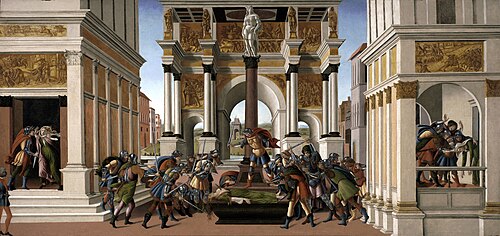
图:Sandro Botticelli · Public domain · 维基共享资源
- 时间
- 公元前 510 年—公元前 509 年
- 地点
- 古罗马
- 国家 / 地区
- 罗马王政时代
- 前一事件
- Second Roman Kingdom
- 后一事件
- Early Roman Republic
- 类型
- 革命
- 简述
- Political revolution (traditionally 509 BC) which expelled the last king of Rome and established the Roman Republic
罗马君主制的推翻是指公元前六世纪至公元前五世纪之间的古罗马历史事件,当时罗马国王卢基乌斯·塔奎尼乌斯·苏培布斯被推翻,罗马共和国成立。几个世纪后的罗马人基本上忘记了该事件的细节。后来古罗马历史学家试图重现这一历史事件的细节,并将该事件的起始时间定为公元前509年,但许多现代学者认为事件细节很有可能是古罗马历史学家虚构的。
正文摘自中文维基百科「罗马君主制的推翻」(删去了参考文献、表格和图片),按 CC BY-SA 4.0 使用
英文维基百科的更多内容
中文维基百科这一条比较短,下面是英文维基百科同一条目的节选,原文为英文,未翻译。
The overthrow of the Roman monarchy was an event in ancient Rome that took place between the 6th and 5th centuries BC where a political revolution replaced the then-existing Roman monarchy under Lucius Tarquinius Superbus with a republic. The details of the event were largely forgotten by the Romans a few centuries later; later Roman historians presented a narrative of the events, traditionally dated to c. 509 BC, but it is largely believed by modern scholars to be fictitious.
The traditional account portrays a dynastic struggle in which the king's second son, Sextus Tarquinius, rapes a noblewoman, Lucretia. Upon revealing the assault to some Roman noblemen, she kills herself. The Roman noblemen, led by Lucius Junius Brutus, obtain the support of the Roman aristocracy and the people to expel the king and his family and create a republic. The Roman army, supporting Brutus, forces the king into exile. Despite a number of attempts by Lucius Tarquinius Superbus to reinstate the monarchy, the Roman people are successful in establishing a republic and thereafter elected two consuls annually to rule the city.
Many modern scholars dismiss this narrative as fictitious. There does not exist, however, any concrete evidence for or against it. Various scholars have dismissed aspects of the traditional story, from the historicity of almost all of its major characters to the overthrow's entire existence.
Chronology
Scholars and the ancient sources themselves disagree on when the monarchy was overthrown and how old the resulting republic was. The most well-known date for the establishment of the republic, and therefore, the expulsion of the kings, is 509 BC. The specific dating to 509 BC emerges from the Varronian chronology, assembled during the late republic by Marcus Terentius Varro and later used by the fasti Capitolini, which likely – in the earlier period – runs four years behind the actual dates (i.e. Varronian year 344 corresponds to real year 340 BC).
Traditional account
Roman tradition held that there were seven kings of Rome who reigned from the city's founding (traditionally dated to 753 BC) by Romulus up to the reign of Tarquin. Archaeological evidence indicates there were kings in Rome; but most scholars do not believe that the traditional narrative is historical, ascribing its characters and details to later literary invention.
Account
According to the traditional account, a group of aristocrats overthrow the last king, Lucius Tarquinius Superbus, in response to the rape of the noblewoman Lucretia by the king's second son, Sextus Tarquinius;……
Modern theories
There are many different theories about what happened at the start of the republic. The evidence is sufficiently sparse that many stories can be plausibly put forth. Modern views range from a semi-traditional account accepting the general facts of Roman tradition to hyper-critical accounts which argue that basically all of Rome's early history are the result of "artificial numerological exercises" and almost pure invention from association with other historical events.
Semi-traditionalist approach
The semi-traditionalist approach is built on a methodology of accepting Roman tradition as correct in terms of broad events, but discarding the narrative details themselves as fictitious.……
Legacy
Political influence
The putative role of Lucius Junius Brutus in the abolition of the kings was commemorated by the later Romans with a statue on the Capitoline Hill – holding an unsheathed sword – in front of the statues of the seven kings of Rome. The story of his overthrow was also referenced by the public as part of a campaign to convince one of his descendants, Marcus Junius Brutus, to organise the assassination of Julius Caesar.
Praise of Brutus, both the one who expelled the kings and the one who killed Caesar, was common during the French Revolution; the name was appropriated as an exemplar of civic republican virtues and citizenship.……
正文摘自英文维基百科(原文为英文,未翻译)「Overthrow of the Roman monarchy」(节选,删去了参考文献、表格和图片),按 CC BY-SA 4.0 使用;在维基百科读全文 ›
相关政权

同时期、同地区的大事
- 希波战争公元前 499 年—公元前 449 年 · 战争 · 欧洲