 史鉴
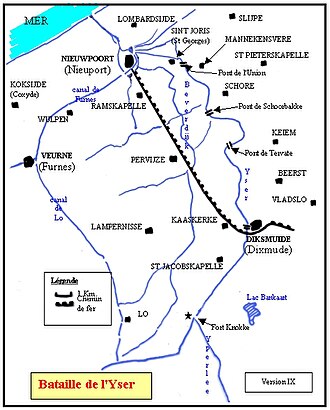
图:Fistos · CC BY-SA 3.0 · 维基共享资源
- 时间
- 1914 年 10 月 16 日—1914 年 10 月 31 日
- 地点
- 艾泽尔河
- 国家 / 地区
- 比利时
- 参与方
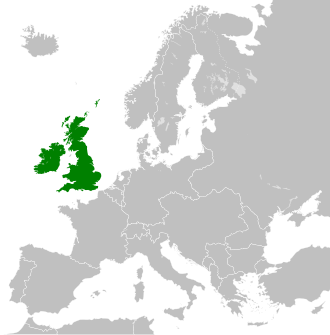
- 大不列颠及爱尔兰联合王国
- 属于
- 奔向大海
- 类型
- 战役
- 简述
- battle of World War I between Germany and the Allied Forces, fought along the Yser River and the Yperlee Canal in Belgium
艾泽尔河战役(荷兰语:Slag om de IJzer;法语:Bataille de l'Yser)是第一次世界大战西线中的一场战役,于1914年10月在尼乌波特和迪克斯迈德之间发生,战线全长35公里,位于比利时的艾泽尔河和伊珀尔莱运河的延伸段。前线由一支的比利时-法国部队驻守,在一场防御战中阻止了德军的前进。
艾泽尔河战役的胜利使得比利时保留了一小块领土,这使阿尔贝一世成为比利时的民族英雄。
正文摘自中文维基百科「艾泽尔河战役」(删去了参考文献、表格和图片),按 CC BY-SA 4.0 使用
英文维基百科的更多内容
中文维基百科这一条比较短,下面是英文维基百科同一条目的节选,原文为英文,未翻译。
The Battle of the Yser was a battle of the First World War that took place in October 1914 between the towns of Nieuwpoort and Diksmuide, along a 35 km (22 mi) stretch of the Yser River and the Yperlee Canal, in Belgium. The front line was held by a large Belgian force, which halted the German advance in a costly defensive battle.
The victory at the Yser allowed Belgium to retain a small strip of territory, with Germany in control of 95 per cent of Belgian territory, which made King Albert a Belgian national hero, sustained national pride and provided a venue for commemorations of heroic sacrifice for the next hundred years.
Background
German invasion of Belgium
On 2 August 1914, the Belgian government refused passage through Belgium to German troops and on the night of 3/4 August the Belgian General Staff ordered the Third Division to Liège to obstruct a German advance. The German army invaded Belgium on the morning of 4 August. Covered by the Third Division, the Liège fortress garrison, a screen of the Cavalry Division and detachments from Liège and Namur, the Belgian field army closed up to the river Gete and by 4 August, the First Division had assembled at Tienen, the Fifth Division at Perwez, the Second Division at Leuven and the Sixth Division at Wavre, covering central and western Belgium and communications towards Antwerp. German cavalry appeared at Visé early on 4 August, to find the bridge down and Belgian troops on the west bank;……
Prelude
The Belgian retreat continued on 11 and 12 October, covered by cavalry, cyclists and motor machine-gun sections. On 14 October, the Belgian army began to dig in along the Yser, the Sixth and Fifth divisions to the north of French territorial divisions, assembled at Boezinge (Boesinghe), then northwards along the Yser canal to the Fusiliers Marins at Diksmuide (Dixmude). The Fourth, First and Second divisions prolonged the line north, with advanced posts at Beerst, Keiem (Keyem), Schoore and Mannekensvere, about 1 mi (2 km) forward on the east bank. A bridgehead was also held near the coast around Lombartzyde and Westende, to cover Nieuwpoort (Nieuport), with the 2nd Cavalry Division in reserve.……
Battle
On 16 October Diksmuide, garrisoned by Belgian and French troops (Colonel Alphonse Jacques), was attacked. Despite many casualties, the Belgians and French held the town. The press, politicians, literary figures and the military manipulated public opinion, making out that the defence of the town was strategically-important and heroic.
On 18 October, the German offensive began and overran Allied troops from Nieuwpoort southwards to Arras. The objective was to defeat the Belgian and French armies and to deprive the British of access to Calais, Boulogne and Dunkirk. The III Reserve Corps attacked Belgian defences from Diksmuide to the sea, regardless of loss.……
Aftermath
Analysis
The Belgian Army and its allies had managed to hold the last corner of Belgium, ending the Race to the Sea and the period of open warfare. The front line along the Yser River became known as the Yser Front and was held by the Belgian Army until 1918. The struggle of the Belgian army to hold on to its territory during the remainder of the war and the experiences of ordinary Flemish infantrymen, led to an increase in Flemish national sentiment and the foundation of the Frontbeweging, the first party of the Flemish Movement, in 1917.
Casualties
The British official historian, James Edmonds, wrote in 1925, in the second 1914 volume of the History of the Great War, that from 18 October to 30 November 1914, between Gheluvelt and the coast, the Germans suffered an estimated 76,250 casualties.……
正文摘自英文维基百科(原文为英文,未翻译)「Battle of the Yser」(节选,删去了参考文献、表格和图片),按 CC BY-SA 4.0 使用;在维基百科读全文 ›
相关人物
相关政权
同时期、同地区的大事
- 大萧条1929 年 10 月 29 日—1941 年 · 时代与时期 · 欧洲
- 凡尔赛条约1920 年 1 月 10 日 · 条约与会议 · 欧洲
- 十月革命1917 年 10 月 25 日—1917 年 10 月 26 日 · 革命与起义 · 欧洲
- 国家社会主义德国工人党1920 年 2 月 24 日—1945 年 10 月 10 日 · 其他事件 · 欧洲
- 党卫队1925 年 4 月 4 日—1945 年 5 月 8 日 · 其他事件 · 欧洲
- 德国国旗1917 年 · 其他事件 · 欧洲
- 俄国二月革命1917 年 3 月 8 日—1917 年 3 月 16 日 · 革命与起义 · 欧洲
- 巴黎和会1919 年 1 月 18 日—1920 年 1 月 21 日 · 其他事件 · 欧洲
- 巴尔干战争1912 年 10 月 8 日—1913 年 7 月 18 日 · 战争 · 欧洲
- 同盟国1914 年—1918 年 11 月 11 日 · 其他事件 · 欧洲
- 第一次巴尔干战争1912 年 10 月 8 日—1913 年 5 月 30 日 · 战争 · 欧洲
- 洛桑条约1923 年 7 月 24 日 · 条约与会议 · 欧洲
同时期的同类事件(战役)
- 斯大林格勒战役1942 年 8 月 23 日—1943 年 2 月 2 日 · 战役 · 欧洲
- 巴巴罗萨行动1941 年 6 月 22 日—1941 年 12 月 5 日 · 战役 · 欧洲
- 珍珠港事件1941 年 12 月 7 日 · 战役 · 大洋洲
- 波兰战役1939 年 9 月 1 日—1939 年 10 月 6 日 · 战役 · 欧洲
- 不列颠战役1940 年 7 月 10 日—1940 年 10 月 31 日 · 战役 · 欧洲
- 加里波利之战1915 年 4 月 25 日—1916 年 1 月 9 日 · 战役 · 西亚
- 法国战役1940 年 5 月 10 日—1940 年 6 月 25 日 · 战役 · 欧洲
- 海王行动1944 年 6 月 6 日—1944 年 8 月 29 日 · 战役 · 欧洲
- 库尔斯克会战1943 年 7 月 5 日—1943 年 8 月 23 日 · 战役 · 欧洲
- 列宁格勒围城战1941 年 9 月 8 日—1944 年 1 月 27 日 · 战役 · 欧洲
- 凡尔登战役1916 年 2 月 21 日—1916 年 12 月 18 日 · 战役 · 欧洲
- 索姆河战役1916 年 7 月 1 日—1916 年 11 月 17 日 · 战役 · 欧洲