 史鉴
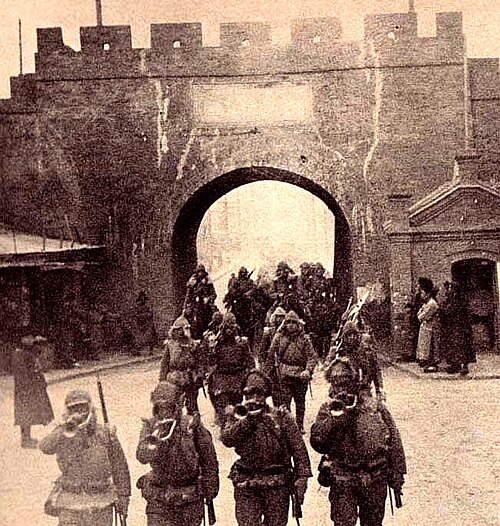
图:Osaka Mainichi war cameramen · Public domain · 维基共享资源
- 时间
- 1931 年 9 月 18 日—1932 年 2 月 27 日
- 地点
- 内满洲
- 参与方
- 大日本帝国、大日本帝国陆军、国民革命军、中华民国
- 属于
- 中国抗日战争
- 类型
- 入侵
- 简述
- 1931年九一八事变后日军对中国东北的入侵
1931年9月18日,日本关东军发动九一八事变(日本军以侵略为借口开展的假旗行动),随后立即入侵中华民国满洲地区。
正文摘自中文维基百科「日本入侵中国东北」(删去了参考文献、表格和图片),按 CC BY-SA 4.0 使用
英文维基百科的更多内容
中文维基百科这一条比较短,下面是英文维基百科同一条目的节选,原文为英文,未翻译。
The Empire of Japan's Kwantung Army invaded the Manchuria region of China on 18 September 1931, immediately following the Mukden incident, a false flag event staged by Japanese military personnel as a pretext to invade. At the war's end in February 1932, the Japanese established the puppet state of Manchukuo. The occupation lasted until mid-August 1945, towards the end of the Second World War, in the face of an onslaught by the Soviet Union and Mongolia during the Manchurian Strategic Offensive Operation.
With the invasion having attracted great international attention, the League of Nations produced the Lytton Commission (headed by British politician Victor Bulwer-Lytton) to evaluate the situation, with the organization delivering its findings in October 1932. Its findings and recommendations, namely that the Japanese puppet state of Manchukuo was not to be recognized, and Manchuria had to be returned to Chinese sovereignty, prompted the Japanese government to withdraw from the League entirely.
Background
Since the end of the Russo-Japanese War in 1905, the Liaodong peninsula was a leased territory of Japan. Thus, Tokyo exercised informal rule over Manchuria. Under Japanese control, economic gains increased; by the end of the 1920s, 39.4 percent of all colonial financial investments went into Manchuria.……
Prelude
There were two pivotal events that eventually led up to the invasion of Manchuria. In July 1931, near Changchun in the Wanpaoshan region, a dispute over the construction of an irrigation system by Korean farmers on Chinese-owned land escalated into violence.……
Initial annexation
On September 18, 1931, the Japanese Imperial General Headquarters, which had decided upon a policy of localizing the incident, communicated its decision to the Kwantung Army command.……
Secession movements
After the Liaoning Provincial government fled Mukden, it was replaced by a "Peoples Preservation Committee" which declared the secession of Liaoning province from the Republic of China.……
Resistance to the Japanese invasion
Using the repair of the Nen River Bridge as the pretext, the Japanese sent a repair party in early November under the protection of Japanese troops.……
Operations in southern Northeast China
In late November 1931, General Honjō dispatched 10,000 soldiers in 13 armored trains, escorted by a squadron of bombers, in an advance on Chinchow from Mukden. This force had advanced to within 30 kilometres (19 mi) of Chinchow when it received an order to withdraw.……
Occupation of Northeast China
With southern Manchuria secure, the Japanese turned north to complete the occupation of Manchuria. As negotiations with Generals Ma Zhanshan and Ding Chao to defect to the pro-Japanese side had failed, in early January Colonel Kenji Doihara requested collaborationist General Qia Xi to advance his forces and take Harbin.……
Effect on Japanese homefront
The conquest of Manchuria, a land rich in natural resources, was widely seen as an economic "lifeline" to save Japan from the effects of the Great Depression, generating much public support.……
External effect
The Western media reported on the events with accounts of atrocities such as bombing civilians or firing upon shell-shocked survivors. It aroused considerable antipathy to Japan, which lasted until the end of World War II.……
正文摘自英文维基百科(原文为英文,未翻译)「Japanese invasion of Manchuria」(节选,删去了参考文献、表格和图片),按 CC BY-SA 4.0 使用;在维基百科读全文 ›
下属事件
相关人物
相关政权

同时期、同地区的大事
- 广岛与长崎原子弹爆炸1945 年 8 月 6 日 · 其他事件 · 东亚
- 中国抗日战争1937 年 7 月 7 日—1945 年 9 月 9 日 · 战争 · 东亚
- 国共内战1927 年 8 月 1 日—1950 年 5 月 1 日 · 战争 · 东亚
- 南京大屠杀1937 年 12 月 13 日—1938 年 2 月 2 日 · 屠杀与暗杀 · 东亚
- 硫磺岛战役1945 年 2 月 8 日—1945 年 3 月 26 日 · 战役 · 东亚
- 长征1934 年 10 月 16 日 · 其他事件 · 东亚
- 731部队1936 年—1945 年 · 其他事件 · 东亚
- 阿姆利则血案1919 年 4 月 13 日 · 战役 · 东亚
- 冲绳岛战役1945 年 4 月 1 日—1945 年 6 月 23 日 · 战役 · 东亚
- 九一八事变1931 年 9 月 18 日 · 战争 · 东亚
- 日本投降1945 年 9 月 2 日 · 其他事件 · 东亚
- 关东大地震1923 年 9 月 1 日 · 其他事件 · 东亚
同时期的同类事件(战役)
- 斯大林格勒战役1942 年 8 月 23 日—1943 年 2 月 2 日 · 战役 · 欧洲
- 巴巴罗萨行动1941 年 6 月 22 日—1941 年 12 月 5 日 · 战役 · 欧洲
- 珍珠港事件1941 年 12 月 7 日 · 战役 · 大洋洲
- 第二次中东战争1956 年 10 月 29 日—1956 年 11 月 7 日 · 战役 · 非洲
- 波兰战役1939 年 9 月 1 日—1939 年 10 月 6 日 · 战役 · 欧洲
- 不列颠战役1940 年 7 月 10 日—1940 年 10 月 31 日 · 战役 · 欧洲
- 加里波利之战1915 年 4 月 25 日—1916 年 1 月 9 日 · 战役 · 西亚
- 法国战役1940 年 5 月 10 日—1940 年 6 月 25 日 · 战役 · 欧洲
- 海王行动1944 年 6 月 6 日—1944 年 8 月 29 日 · 战役 · 欧洲
- 柏林战役1945 年 4 月 16 日—1945 年 5 月 2 日 · 战役 · 欧洲
- 库尔斯克会战1943 年 7 月 5 日—1943 年 8 月 23 日 · 战役 · 欧洲
- 列宁格勒围城战1941 年 9 月 8 日—1944 年 1 月 27 日 · 战役 · 欧洲