 史鉴
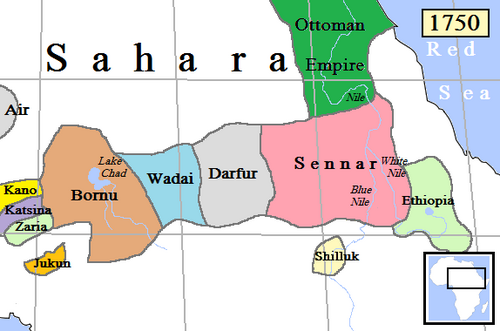
图:Gabagool · CC BY 3.0 · 维基共享资源
- 时间
- 1505 年—1821 年
- 类型
- 苏丹国
- 简述
- sultanate
丰吉苏丹国,又称丰吉斯坦、森纳尔苏丹国、蓝苏丹国,是丰吉人领袖奥马尔·冬卡和阿卜杜拉·詹马于1504年灭亡阿勒底亚后所建,首都森纳尔,领土北达尼罗河第三瀑布。
详细介绍
领土扩张
苏丹巴迪二世将领土将疆域西部推进至科尔多凡东部。巴迪·阿布·西卢克统治时期,版图向东西而向都大大拓展,内政方面废除法律实行独裁,引发贵族不满。
衰亡
1762年,科尔多凡总督起兵废除国王、自此苏丹国陷入内乱。1821年为埃及攻灭。
正文摘自中文维基百科「丰吉苏丹国」(删去了参考文献、表格和图片),按 CC BY-SA 4.0 使用
英文维基百科的更多内容
中文维基百科这一条比较短,下面是英文维基百科同一条目的节选,原文为英文,未翻译。
The Funj Sultanate, also known as Funjistan, Sultanate of Sennar or Blue Sultanate was an Islamic kingdom in what is now Sudan, northwestern Eritrea and western Ethiopia. Succeeding the medieval Nubian kingdoms of Makuria and Alodia, it was established in 1504 by Sultan Amara Dunqas, a convert to Islam who founded its capital Sennar on the Blue Nile. It was dominated by the Funj people, an arabized people of unclear ethnic origin who ruled over an ethnically diverse population including Nubians, Beja, Bedouin and Hamaj. It reached its peak in the late 17th century, when it extended from the Third Cataract southwards to the western fringes of the Ethiopian Highlands and the Sobat River, east to the Red Sea, and west to Kordofan and the Nuba Mountains. It encouraged the spread of Islam by inviting Sufi holymen, which in turn also accelerated Arabization and the formation of the modern Sudanese Arab tribes. In the 18th century the power of the Funj declined, especially after the Hamaj seized power in a coup in 1762. From the late 18th century the Sultanate disintegrated and was torn apart by civil wars. In 1821 the last sultan, greatly reduced in power, was forced to surrender to the Turco-Egyptian conquest.
History
Origins (until early 16th century)
Christian Nubia, represented by the two medieval kingdoms of Makuria and Alodia, began to decline from the 12th century. By 1365 Makuria had virtually collapsed and was reduced to a rump state restricted to Lower Nubia, until finally disappearing c. 150 years later. The fate of Alodia is less clear. It has been suggested that it had collapsed as early as the 12th century or shortly after, as archaeology suggests that in this period, Soba ceased to be used as its capital.……
Government
The royal family traced their lineage to a legendary ancestress. The sultan's successor was chosen by the royal court from sons of previous rulers and Funj noblewomen. A nobleman's status depended on marrying a princess, such that each nobleman owed political favours to whom he received his wife from. They also donated their female kin as wives to their superiors, with the sultan typically having 600 noble wives, a senior nobleman 200, and a lesser lord 30.……
Administration
The sultans of Sennar were powerful, but not absolutely so, as a council of 20 elders also had a say in state decisions.……
Military
The army of Sennar was feudal. Each noble house could field a military unit measured in its power by its horsemen. The population, although generally armed, was only rarely called to war, in cases of uttermost need. Most Funj warriors were slaves traditionally captured in annual slave raids called salatiya, targeting the stateless non-Muslims in the Nuba mountains pejoratively referred to as Fartit.……
Culture
Religion
Islam
By the time of the visit by David Reubeni in 1523, the Funj, originally Pagans or syncretic Christians, had converted to Islam. They probably converted to ease their rule over their Muslim subjects and to facilitate trade with neighbouring countries like Egypt. Their embracement of Islam was only nominal and, in fact, the Funj effectively even delayed the Islamization of Nubia, as they temporarily strengthened African sacral traditions instead.……
Christianity
The collapse of the Christian Nubian states went hand in hand with the collapse of the Christian institutions.……
Economy
Most of the sultanate's wealth was derived from the land (technically belonging to the sultan), and the economy was based on agriculture. Lesser lords paid tribute to their political superiors in the form of goods such as cloth, tobacco, gold, ivory, horses, medicines, spices, and perfumes, and senior noblemen redistributed wealth derived from governmental practices among their subordinates, such as slaves derived from the judicial system or warfare.……
Trade
During the reign of sultan Badi III in the late 17th and early 18th century the prosperous and cosmopolitan capital of Sennar was described as "close to being the greatest trading city" in all Africa.……
Rulers
The rulers of Sennar held the title of Mek (sultan). Their regnal numbers vary from source to source.
Hamaj regents
- Muhammad Abu Likayik 1769 – 1775/6
- Badi walad Rajab 1775/1776 – 1780
- Rajab 1780 – 1786/1787
- Nasir 1786/1787 – 1798
- Idris wad Abu Likaylik 1798 – 1803
- Adlan wad Abu Likayik 1803
- Wad Rajab 1804 – 1806
正文摘自英文维基百科(原文为英文,未翻译)「Funj Sultanate」(节选,删去了参考文献、表格和图片),按 CC BY-SA 4.0 使用;在维基百科读全文 ›
同时期、同地区的大事
- 葡属东非1498 年—1975 年 6 月 25 日 · 时代与时期 · 非洲
同时期的同类事件(时代与时期)
- 宗教改革1517 年 10 月 31 日—1648 年 · 时代与时期
- 16世纪1501 年 1 月 1 日—1600 年 12 月 31 日 · 时代与时期
- 地理大发现15 世纪—18 世纪 · 时代与时期
- 近世15 世纪—18 世纪 · 时代与时期
- 新法兰西1534 年—1763 年 · 时代与时期 · 北美洲
- 新西班牙总督辖区1521 年 8 月 18 日—1820 年 5 月 31 日 · 时代与时期 · 拉丁美洲
- 风格主义1520 年—1600 年 · 时代与时期
- 美洲殖民1492 年 · 时代与时期
- 西班牙宗教裁判所1478 年—1834 年 · 时代与时期 · 欧洲
- 旧制度15 世纪—1789 年 8 月 · 时代与时期 · 欧洲
- 西班牙美洲殖民地1493 年 9 月 24 日—1898 年 7 月 13 日 · 时代与时期
- 葡属印度1505 年—1961 年 · 时代与时期 · 东南亚