 史鉴
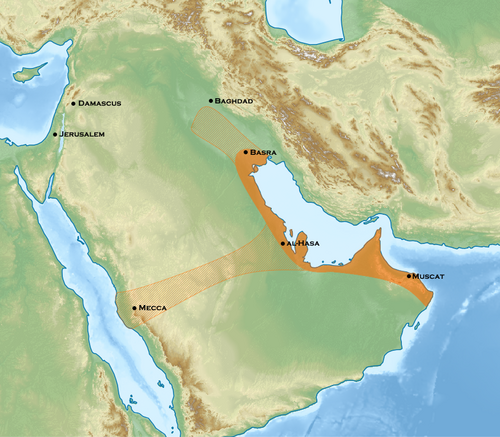
图:Dpstoksy · CC0 · 维基共享资源
- 时间
- 8 世纪 (Wikidata 的日期只记到世纪,非确切年份)
- 国家 / 地区
- Qarmatian state of Bahrayn
- 类型
- 教派、religious group
- 简述
- 宗教团体
卡尔马特派(阿拉伯语:قرامطة)是伊斯玛仪派中的一个派别,卡尔马特派的信众于899年在哈萨绿洲建国,并且与法蒂玛王朝和阿拔斯王朝作战。1067年,卡尔马特派消亡。
正文摘自中文维基百科「卡尔马特派」(删去了参考文献、表格和图片),按 CC BY-SA 4.0 使用
英文维基百科的更多内容
中文维基百科这一条比较短,下面是英文维基百科同一条目的节选,原文为英文,未翻译。
The Qarmatians were an Isma'ili Shia militant movement led by an Arabized dynasty of Persian descent. Claiming an Alid descent, the Qarmatians were centred in al-Ahsa in Eastern Arabia, where they established a religious state in 899 CE. The Qarmatians adhered to a syncretic branch of Sevener Ismaili Shia Islam, and were ruled by a dynasty founded by Abu Sa'id al-Jannabi. They rejected the claim of the Fatimid caliph Abdallah al-Mahdi Billah to the imamate and, clinging to their belief in the coming of the Mahdi, revolted against both the Fatimid and Abbasid caliphates.
The Qarmatians are perhaps most notable for sacking Mecca in 930 CE under the leadership of Abu Tahir al-Jannabi. This violent act outraged the contemporary Muslim world, particularly because of their theft of the Black Stone and the desecration of the Zamzam Well with the corpses of pilgrims during the Hajj season.
Name and origin
The origin of the name "Qarmatian" is uncertain. According to some sources, the name derives from the surname of the sect's founder, Hamdan Qarmat. The name qarmat probably comes from the Aramaic for "short-legged", "red-eyed" or "secret teacher". Other sources, however, say that the name comes from the Arabic verb قرمط (qarmaṭ), which means "to make the lines close together in writing" or "to walk with short steps". The word "Qarmatian" can also refer to a type of Arabic script.
The Qarmatians in Sawad (southern Iraq) were also known as "the Greengrocers" (al-Baqliyyah) because they followed the teachings of Abu Hatim al-Zutti, who in 908 forbade animal slaughter.……
History
Early developments
Under the Abbasid Caliphate (750–1258 CE), various Shiite groups organised in secret opposition to their rule. Among them were the supporters of the proto-Isma'ili community, of whom the most prominent group were called the Mubarakiyyah.
According to the Ismaili school of thought, Imām Ja'far al-Sadiq (702–765) designated his second son, Isma'il ibn Ja'far (c. 721–755), as heir to the Imamate. However, Ismā‘īl predeceased his father. Some claimed he had gone into hiding, but the proto-Isma'ili group accepted his death and therefore accordingly recognized Isma'il's eldest son, Muhammad ibn Isma'il (746–809), as Imam. He remained in contact with the Mubarakiyyah group, most of whom resided in Kufa.
Qarmatian Revolution
A change in leadership in Salamiyah in 899 led to a split in the movement.……
Imamate of Seven Imams
According to Qarmatians, the number of imams was fixed, with Seven Imāms preordained by God. These groups considers Muhammad ibn Isma'il to be the messenger – prophet (Rasūl), Imam al-Qa'im and Mahdi to be preserved in hiding, which is referred to as Occultation.
Ismaili imams not accepted as legitimate by Qarmatians
In addition, the following Ismaili imams after Muhammad ibn Isma'il had been considered heretics of dubious origins by certain Qarmatian groups, who refused to acknowledge the imamate of the Fatimids and clung to their belief in the coming of the Mahdi.
Isma'il ibn Ja'far (765–775)
Abadullah ibn Muhammad (Ahmad al-Wafi) (813–829)
Ahmad ibn Abadullah (Muhammad at-Taqi) (829–840)
Husayn ibn Ahmad (Radi Abdullah) (840–881)
Abdallah al-Mahdi Billah (881–934) (Founder of Fatimid Caliphate)
Qarmatian rulers in Eastern Arabia
Abu Sa'id al-Jannabi (894–914)
Abu Tahir al-Jannabi (914–944)
Abu Mansur Ahmad (944–970)
Abu al-Qasim Sa'id (970–972)
Abu Yaqub Yousuf (972–977)
Descendants of Abu Yaqub Yousuf ruled until 1077
Substitution after Abu Tahir al-Jannabi
Farhad Daftary writes about the fate of the successors of Abu Tahir al-Jannabi:
It may be noted that at the time the Qarmaṭī state was still being ruled jointly by Abū Ṭāhir’s brothers. Abū Ṭāhir’s eldest son Sābūr (Shāpūr), who aspired to a ruling position and the command of the army, rebelled against his uncles in 358/969, but he was captured and executed in the same year. But the ruling sons of Abū Sa'īd al-Jannābī themselves did not survive much longer. Abū Manṣūr Aḥmad died in 359/970, probably of poisoning, and his eldest brother Abu’l-Qāsim Sa'īd died two years later. By 361/972, there remained of Abū Ṭāhir’s brothers only Abū Ya'qūb Yūsuf, who retained a position of pre-eminence in the Qarmaṭī state.……
正文摘自英文维基百科(原文为英文,未翻译)「Qarmatians」(节选,删去了参考文献、表格和图片),按 CC BY-SA 4.0 使用;在维基百科读全文 ›