 史鉴
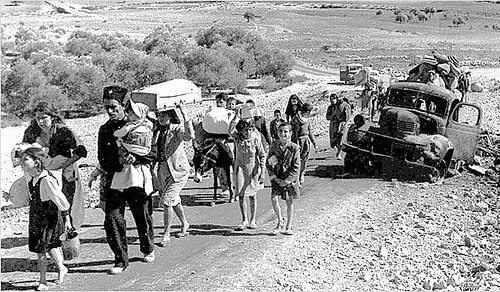
图:Fred Csasznik · Public domain · 维基共享资源
- 时间
- 1948 年
- 国家 / 地区
- 英属巴勒斯坦托管地
- 属于
- 第一次中东战争、大灾难 (巴勒斯坦)
- 起因
- 中东战争、联合国大会181号决议、巴勒斯坦政治暴力、锡安主义者政治暴力
- 后一事件
- 1949—1956年巴勒斯坦人的驱逐
- 类型
- 种族清洗、mass migration、exodus
- 简述
- ethnic cleansing, expulsion, and flight of Palestinians during the 1948 Palestine war
During the 1948 Palestine war, more than 700,000 Palestinian Arabs – about half of Mandatory Palestine's predominantly Arab population – were expelled or fled from their homes. Expulsions and attacks against Palestinians were carried out by the Zionist paramilitaries Haganah, Irgun, and Lehi, which merged to become the Israel Defense Forces after the establishment of Israel part way through the war. The expulsion and flight was a central component of the fracturing, dispossession, and displacement of Palestinian society, known as the Nakba.
Dozens of massacres targeting Arabs were conducted by Israeli military forces and between 400 and 600 Palestinian villages were destroyed. The Israeli military operated labor camps for captured Palestinians, most of whom were civilians. Village wells were poisoned in a biological warfare programme, properties were looted to prevent Palestinian refugees from returning, and some sites were renamed.
The precise number of Palestinian refugees, many of whom settled in Palestinian refugee camps in neighboring states, is a matter of dispute, although the number is around 700,000, being approximately 80 percent of the Arab inhabitants of what became Israel. About 250,000–300,000 Palestinians fled or were expelled during the 1947–1948 civil war in Mandatory Palestine, before the termination of the British Mandate on 14 May 1948. The desire to prevent the collapse of the Palestinians and to avoid more refugees are cited as one of the reasons for the 1948 Arab–Israeli War.
详细介绍
History
The history of the Palestinian exodus is closely tied to the events of the war in Palestine, which lasted from 1947 to 1949, and to the political events preceding it. The first phase of that war began on 30 November 1947, a day after the United Nations adopted the Partition Plan for Palestine, which split the territory into Jewish and Arab states, and an international Jerusalem.
December 1947 – March 1948
In the first few months of the civil war, the climate in the Mandate of Palestine became volatile, although throughout this period both Arab and Jewish leaders tried to limit hostilities.……
Contemporary mediation and the Lausanne Conference
UN mediation
The United Nations, using the offices of the United Nations Truce Supervision Organization and the Mixed Armistice Commissions, was involved in the conflict from the very beginning. In the autumn of 1948 the refugee problem was a fact and possible solutions were discussed. Count Folke Bernadotte said on 16 September:
No settlement can be just and complete if recognition is not accorded to the right of the Arab refugee to return to the home from which he has been dislodged.……
Lausanne Conference of 1949
At the start of the Lausanne Conference of 1949, on 12 May 1949, Israel agreed in principle to allow the return of some of the Palestinian refugees.……
Results of the Palestinian exodus
The expulsion of Palestinians in 1947–49 resulted in the significant depopulation of territory occupied by Israel, in which "about 90 percent of the Palestinians were ethnically cleansed – many by psychological warfare and /or military pressure and a large number at gunpoint." Historic Arabic place names were replaced with Hebrew names, based on biblical names.
Economic damage
As towns and villages were either conquered or abandoned in the conflict, looting by Jewish forces and residents was widespread.……
Abandoned, evacuated and destroyed Palestinian localities
Several authors have conducted studies on the number of Palestinian localities that were abandoned, evacuated or destroyed during the 1947–1949 period.……
Israeli censorship of documents
Following the large-scale declassification of Israeli archival material in the 1980s, additional information about the circumstances surrounding the expulsion and flight of Palestinians became available, contributing to modern understandings of these events. At the same time, there has been evidence of Defense Ministry officials searching Israeli archives to remove previously declassified documents evidencing Israeli massacres of Palestinian villagers in 1947 and 1948 that led to the Palestinian expulsion and flight.
Historiography
In the first decades after the exodus, two diametrically opposed schools of analysis could be distinguished.
Ian Black at The Guardian noted in 2010 that the events of the Nakba were by that point "widely described" as involving ethnic cleansing, with Israeli documents from 1948 themselves using the term "to cleanse" when referring to uprooting Arabs. Not all historians accept this characterization.……
Films
Al-Nakba: The Palestinian Catastrophe 1948 (1997), a documentary film by Benny Brunner and Alexandra Jansse that follows the events surrounding the creation of the Palestinian refugee problem.
500 Dunam on the Moon (2002), a documentary film directed by Rachel Leah Jones about Ayn Hawd, a Palestinian village that was captured and depopulated by Israeli forces in the 1948 war.
The Sons of Eilaboun (2007), a documentary film by Hisham Zreiq that tells the story of the exodus and return of a small Palestinian village called Eilaboun in 1948.
正文摘自英文维基百科(原文为英文,未翻译)「1948 Palestinian expulsion and flight」(节选,删去了参考文献、表格和图片),按 CC BY-SA 4.0 使用;在维基百科读全文 ›
下属事件
- Tantura massacre1948 年 5 月 23 日 · 屠杀与暗杀 · 西亚
- Al-Dawayima massacre1948 年 10 月 29 日 · 屠杀与暗杀 · 西亚
- Safsaf massacre1948 年 10 月 29 日 · 屠杀与暗杀 · 西亚
同时期、同地区的大事
- 中东战争1948 年 5 月 15 日 · 其他事件 · 西亚
- 巴以冲突1948 年 5 月 14 日 · 其他事件 · 西亚
- 复兴党1947 年 4 月 7 日—1966 年 2 月 23 日 · 其他事件 · 西亚
- 第一次中东战争1947 年 11 月 30 日—1949 年 7 月 20 日 · 战争 · 西亚
- 第二次意大利埃塞俄比亚战争1935 年 10 月 3 日—1937 年 2 月 19 日 · 战争 · 西亚
- 大灾难 (巴勒斯坦)1948 年 · 时代与时期 · 西亚
- 1953年伊朗政变1953 年 8 月 18 日—1953 年 8 月 19 日 · 革命与起义 · 西亚
- 1948年阿拉伯-以色列战争1948 年 5 月 15 日—1949 年 3 月 10 日 · 战争 · 西亚
- 英苏入侵伊朗1941 年 8 月 25 日—1941 年 9 月 17 日 · 战役 · 西亚
- 英国伊拉克战争1941 年 5 月 2 日—1941 年 5 月 31 日 · 战争 · 西亚
- 白色革命1963 年—1979 年 · 革命与起义 · 西亚
- 厄立特里亚独立战争1961 年 9 月 1 日—1991 年 5 月 29 日 · 战争 · 西亚