 史鉴
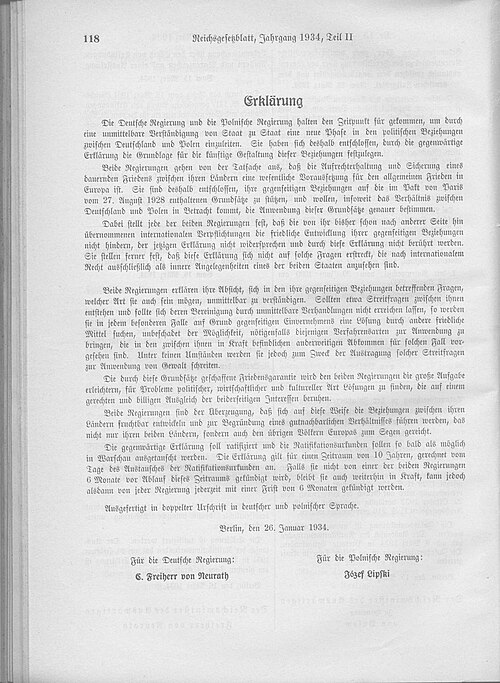
图:official juridical document · Public domain · 维基共享资源
- 时间
- 1934 年 1 月 26 日
- 地点
- 柏林
- 国家 / 地区
- 德国
- 类型
- 和平条约
- 简述
- 1934 peace treaty
德波互不侵犯条约(德语:Erklärung zwischen Deutschland und Polen über den Verzicht auf Gewaltanwendung,波兰语:Deklaracja między Polską a Niemcami o niestosowaniu przemocy),是纳粹德国与波兰第二共和国于 1934 年 1 月 26 日在柏林签署的协议。 两国保证通过双边谈判解决问题,并确在 10 年内放弃两国之间任何武装冲突。该协议有效地实现了波兰和德国之间关系的正常化,两国关系曾因凡尔赛条约中的领土解决方案引起的边界争端而变得紧张,但条约签订后德国实际上承认了对波兰的边界,该声明也标志着过去十年中两国之间的关税战的结束。
正文摘自中文维基百科「德波互不侵犯条约」(删去了参考文献、表格和图片),按 CC BY-SA 4.0 使用
英文维基百科的更多内容
中文维基百科这一条比较短,下面是英文维基百科同一条目的节选,原文为英文,未翻译。
The German–Polish declaration of non-aggression, also known as the German–Polish non-aggression pact, was an agreement between Nazi Germany and the Second Polish Republic that was signed on 26 January 1934 in Berlin.
Both countries pledged to resolve their problems by bilateral negotiations and to forgo armed conflict for a period of 10 years. The agreement effectively normalised relations between Poland and Germany, which had been strained by border disputes arising from the territorial settlement in the Treaty of Versailles. The declaration marked an end to an economically damaging customs war between the two countries that had taken place over the previous decade.
Background
In 1925, under the Locarno Treaties, it was agreed that France would never send forces into Germany outside of its own occupation zone in the Rhineland and that both Britain and Italy would guarantee the Franco-German border against any attempt to change it from either side. The purpose of the Locarno treaties was to make it impossible for France to occupy the Ruhr, as had happened in 1923.……
Negotiations
A détente began between Poland and Germany in early 1933. That was promoted by Józef Beck making what Hans-Adolf von Moltke interpreted as "a veiled proposal for direct contact with Germany" in April 1933. Hitler encouraged that by stating on 2 May 1933 by saying to Alfred Wysocki that he did not "share the view that questions Poland's right to exist" and then on 17 May in a speech to the Reichstag that he did not believe it to be possible to "make Germans out of Poles". That was followed by a lessening of tensions around Danzig in July 1933, with Piłsudski instructing Beck to explore options for further talks.……
Declaration
Naming
The German foreign ministry insisted that the agreement be called a "declaration". rather than a "pact", which was seen as implying that there was no conflict of interest between the parties. Additionally, the Germans believed that it "might imply recognition of the German-Polish border. Despite this the agreement is still referred to as a "pact" in some documents.
Effect of the declaration
Under the declaration, Poland and Germany agreed to normalise relations. Until then, Germany had withheld normalisation without first settling the question of the German-Polish border.……
Aftermath
International reactions
The British government was generally pleased by the German-Polish declaration and believed that it removed a dangerous threat to peace.
In Czechoslovakia, the agreement angered the political elite. The announcement of the declaration came just four days after discussions between Józef Beck and Czechoslovak Foreign Minister Edvard Beneš, who speaking to Joseph Addison, the British ambassador in Prague, claimed that the agreement was a "stab in the back" and went on to say that it showed that Poland was a "useless country" that deserved another partition.……
German denunciation
German policy changed drastically in late 1938, after the annexation of Sudetenland sealed the fate of Czechoslovakia, and Poland became Hitler's next target.……
Legacy
Historiography
The historical significance of the agreement has been a matter of controversy. The British historian Hugh Seton-Watson, writing in 1945, stated that the 1934 declaration "marked the beginning of German-Polish active cooperation in an aggressive policy in Eastern Europe". Similarly, A. J. P. Taylor, in his 1961 book The Origins of the Second World War, considered that the declaration had removed the possibility of Polish support for France and freed Hitler to take further actions.
Later historians have been less critical of the agreement.……
Russian conspiracy theories
On 1 September 2009, on the 70th anniversary of the beginning of the Second World War, Russia's foreign intelligence agency, the SVR, declassified documents it said were gathered by undercover agents between 1935 and 1945 allegedly showing that Poland had secretly conspired with Germany against the Soviet Union.……
正文摘自英文维基百科(原文为英文,未翻译)「German–Polish declaration of non-aggression」(节选,删去了参考文献、表格和图片),按 CC BY-SA 4.0 使用;在维基百科读全文 ›
同时期、同地区的大事
- 犹太人大屠杀1933 年—1945 年 · 屠杀与暗杀 · 欧洲
- 大萧条1929 年 10 月 29 日—1941 年 · 时代与时期 · 欧洲
- 奥斯威辛集中营1940 年 5 月 20 日—1945 年 1 月 27 日 · 其他事件 · 欧洲
- 西班牙内战1936 年 7 月 18 日—1939 年 4 月 1 日 · 战争 · 欧洲
- 凡尔赛条约1920 年 1 月 10 日 · 条约与会议 · 欧洲
- 国家社会主义德国工人党1920 年 2 月 24 日—1945 年 10 月 10 日 · 其他事件 · 欧洲
- 斯大林格勒战役1942 年 8 月 23 日—1943 年 2 月 2 日 · 战役 · 欧洲
- 苏德互不侵犯条约1939 年 8 月 23 日—1941 年 6 月 22 日 · 其他事件 · 欧洲
- 党卫队1925 年 4 月 4 日—1945 年 5 月 8 日 · 其他事件 · 欧洲
- 盖世太保1933 年 4 月 26 日—1945 年 5 月 8 日 · 其他事件 · 欧洲
- 意大利国旗1946 年 6 月 18 日 · 其他事件 · 欧洲
- 冬季战争1939 年 11 月 30 日—1940 年 3 月 13 日 · 战争 · 欧洲
同时期的同类事件(条约与会议)
- 雅尔塔会议1945 年 2 月 4 日—1945 年 2 月 11 日 · 条约与会议 · 欧洲
- 南极条约体系1959 年 12 月 1 日 · 条约与会议
- 慕尼黑协定1938 年 9 月 30 日 · 条约与会议 · 欧洲
- 波茨坦会议1945 年 7 月 17 日—1945 年 8 月 2 日 · 条约与会议 · 欧洲
- 洛桑条约1923 年 7 月 24 日 · 条约与会议 · 欧洲
- 布列斯特-立托夫斯克和约1918 年 3 月 3 日 · 条约与会议 · 欧洲
- 特里亚农条约1920 年 6 月 4 日 · 条约与会议 · 欧洲
- 色佛尔条约1920 年 8 月 10 日 · 条约与会议 · 欧洲
- 赛克斯-皮科协定1916 年 5 月 16 日 · 条约与会议
- 反共产国际协定1936 年 11 月 25 日 · 条约与会议 · 欧洲
- 非战公约1929 年 7 月 24 日 · 条约与会议 · 欧洲
- 布雷顿森林协定1944 年 7 月 22 日 · 条约与会议 · 北美洲