 史鉴
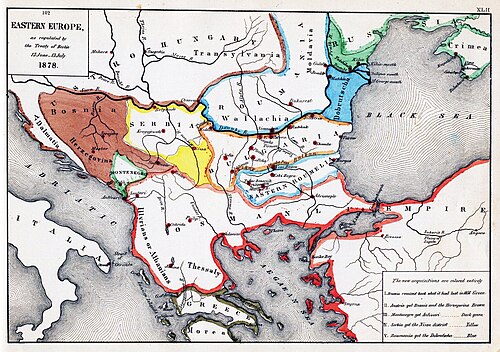
图:Robert H. Labberton, E. Elaxton and Co. · Public domain · 维基共享资源
详细介绍
条款
《柏林条约》确认原属奥斯曼帝国的罗马尼亚、塞尔维亚、黑山独立;而保加利亚则获得自治权,但仍然由土耳其拥有统治权和宗主权,保加利亚部分被一分为二,北部成立保加利亚大公国;南部则设置东鲁米利亚自治省,彻底破坏了俄国当初的“大保加利亚”计划。奥斯曼的波斯尼亚-黑塞哥维那与桑扎克(Sanjak of Novi Pazar)由奥匈帝国占领和治理,但仍然属于土耳其。
影响
罗马尼亚、塞尔维亚、黑山等巴尔干国家先后在1881年、1882年及1910年独立并建立自己的王国;保加利亚在1885年与东鲁米利亚合并,并在1908年获得独立;奥匈则在同年吞并波黑两省,触发了波斯尼亚危机。
俄国在俄土战争付出的代价甚巨,但最后她的“大保加利亚”计划失败;相反,负责调停的德国却间接让奥匈坐收渔人之利,轻易夺得管理波斯尼亚-黑塞哥维那的权利,故此令德、奥、俄三国结下的三帝同盟崩溃。俾斯麦一方面以德奥同盟拉拢奥国,又在另一边厢以第二次三帝同盟企图让俄国回心转意。这令他的同盟制度更形复杂,也令俄国与德奥的关系愈来愈紧张,导致日后的法俄同盟和德奥义三国同盟。
《柏林条约》在往后的数十年构成很多问题。西欧列强尝试力挽衰弱的奥斯曼帝国于既倒,却因此引起巴尔干半岛的种种纷争——仍然有大量基督教人口由回教的奥斯曼帝国统治。巴尔干人民继续争取自由,于是造成战争与国际危机。
条约其中一大败笔,就是未能确立希腊与奥斯曼帝国的边界。当时而言,这是不可能的事,故此双方在会后才开始谈判,并在1881年定下了初步、不全面的协议。但她们在随后十数年继续陷入纷争。
正文摘自中文维基百科「1878年柏林条约」(删去了参考文献、表格和图片),按 CC BY-SA 4.0 使用
英文维基百科的更多内容
中文维基百科这一条比较短,下面是英文维基百科同一条目的节选,原文为英文,未翻译。
The Treaty of Berlin (formally the Treaty between Austria-Hungary, France, Germany, Great Britain and Ireland, Italy, Russia, and the Ottoman Empire for the Settlement of Affairs in the East) was signed on 13 July 1878. In the aftermath of the Russian victory against the Ottoman Empire in the Russo-Turkish War of 1877–1878, the major powers restructured the map of the Balkan region. They reversed some of the extreme gains claimed by Russia in the preliminary Treaty of San Stefano, but the Ottomans lost their major holdings in Europe. It was one of three major peace agreements in the period after the 1815 Congress of Vienna. It was the final act of the Congress of Berlin (13 June – 13 July 1878) and included the United Kingdom, Austria-Hungary, France, Germany, Italy, Russia and the Ottoman Empire. Chancellor of Germany Otto von Bismarck was the chairman and dominant personality.
The most important task of the Congress was to decide the fate of Bulgaria, but Bulgaria itself was excluded from participation in the talks, at Russian insistence. At the time, as it was not a sovereign state, Bulgaria was not a subject of international law, and the same went for the Bulgarians themselves. The exclusion was already an established fact in the great powers' Constantinople Conference, which had been held one year before without any Bulgarian participation.
The most notable result of the conference was the official recognition of the newly independent states of Romania, Serbia, and Montenegro (which had de facto been acting independently for decades). Furthermore, Russia regained access to the formerly demilitarised Black Sea region.
Background
The Paris Peace Treaty of 1856, which ended the Crimean War, had made the Black Sea a neutral territory. The treaty had protected the Ottoman Empire, ended the Holy Alliance (Austria, Prussia and Russia) and weakened Russia's overall position. In 1870, Russia invoked the doctrine of rebus sic stantibus and effectively terminated the treaty by breaching provisions concerning the neutrality of the Black Sea. The great powers became increasingly convinced that the Ottoman Empire would not be able to hold its territories in Europe.
In 1875, the Herzegovina uprising resulted in the Great Eastern Crisis.……
Terms
The treaty formally recognized the independence of the de facto sovereign principalities of Romania, Serbia and Montenegro (plus their expansion) and the autonomy of Bulgaria although the latter de facto functioned independently and was divided into three parts: the Principality of Bulgaria, the autonomous province of Eastern Rumelia, and Macedonia, which was given back to the Ottomans, thus undoing Russian plans for an independent and Russophile "Greater Bulgaria". The Treaty of San Stefano had created a Bulgarian state, which was just what Britain and Austria-Hungary feared the most.
List of plenipotentiaries
- Ottoman Empire
- Alexander Karatheodori Pasha, Minister of Public Works
- Mehmed Ali Pasha, marshal of the Ottoman army
- Sadullah Pasha, ambassador to Berlin
- United Kingdom
- Benjamin Disraeli, Earl of Beaconsfield, Prime Minister
Robert Gascoyne-Cecil, 3rd Marquess of Salisbury, Foreign Secretary
- Lord Odo Russell, ambassador to Berlin
- Germany and Prussia
Otto von Bismarck, Minister President of Prussia and Chancellor of Germany
Baron Ernst von Bülow, Foreign Minister of Prussia
Chlodwig, Prince of Hohenlohe-Schillingsfürst, ambassador to Paris
- Austria-Hungary
- Gyula, Count Andrássy, Foreign Minister
- Count Alajos Károlyi, ambassador to Berlin
- Baron Heinrich Karl von Haymerle, ambassador to Rome
- France
正文摘自英文维基百科(原文为英文,未翻译)「Treaty of Berlin (1878)」(节选,删去了参考文献、表格和图片),按 CC BY-SA 4.0 使用;在维基百科读全文 ›
相关政权
同时期、同地区的大事
- 普法战争1870 年 7 月 19 日—1871 年 1 月 28 日 · 战争 · 欧洲
- 巴黎公社1871 年 3 月 18 日—1871 年 5 月 28 日 · 其他事件 · 欧洲
- 德意志统一1866 年 8 月 18 日—1871 年 5 月 10 日 · 其他事件 · 欧洲
- 俄土战争1877 年 4 月 24 日—1878 年 3 月 3 日 · 战争 · 欧洲
- 柏林西非会议1884 年 11 月 15 日—1885 年 2 月 26 日 · 其他事件 · 欧洲
- 普奥战争1866 年 6 月 14 日—1866 年 7 月 26 日 · 战争 · 欧洲
- 伯尔尼保护文学和艺术作品公约1886 年 9 月 9 日 · 条约与会议 · 欧洲
- 1878年柏林会议1878 年 6 月 13 日—1878 年 7 月 13 日 · 条约与会议 · 欧洲
- 一月起义1863 年 1 月 22 日—1864 年 · 革命与起义 · 欧洲
- 普丹战争1864 年 2 月 1 日—1864 年 10 月 31 日 · 战争 · 欧洲
- 色当会战1870 年 9 月 1 日—1870 年 9 月 2 日 · 战役 · 欧洲
- 文化斗争1872 年—1878 年 · 时代与时期 · 欧洲
同时期的同类事件(条约与会议)
- 马关条约1895 年 4 月 17 日 · 条约与会议 · 东亚
- 圣斯特凡诺条约1878 年 3 月 3 日 · 条约与会议 · 西亚
- 阿拉斯加易手1867 年 3 月 30 日 · 条约与会议 · 北美洲
- 朴次茅斯和约1905 年 9 月 4 日 · 条约与会议 · 北美洲
- 巴黎条约1856 年 3 月 30 日 · 条约与会议 · 欧洲
- 英法协约1904 年 4 月 8 日 · 条约与会议 · 欧洲
- 法兰克福条约1871 年 11 月 7 日 · 条约与会议 · 欧洲
- 三帝同盟1873 年 10 月 11 日 · 条约与会议
- 巴黎条约1898 年 12 月 10 日 · 条约与会议 · 欧洲
- 瓜达卢佩-伊达尔戈条约1848 年 2 月 2 日 · 条约与会议 · 拉丁美洲
- 神奈川条约1864 年 3 月 31 日 · 条约与会议 · 东亚
- 盖兹登购地1853 年 · 条约与会议 · 北美洲