 史鉴
中国历代 › 十六国
北凉 397 年—439 年
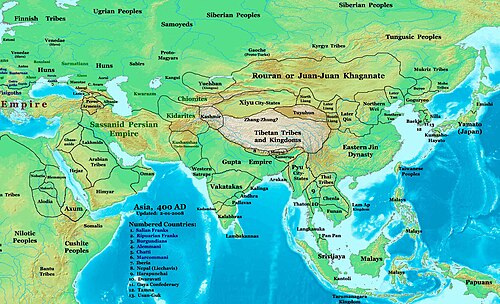
图:Thomas A. Lessman, en:User:Talessman · CC BY-SA 3.0 · 维基共享资源
- 时间
- 397 年—439 年
- 都城
- 张掖、姑臧
- 开国君主
- 段业
- 时间轴分组
- 十六国
- 前身
- 后凉
北凉(397年或401年-439年)是十六国之一。由匈奴支系卢水胡族的首领沮渠蒙逊所建立;另有一种看法认为建立者为段业,此说是以蒙逊堂兄沮渠男成拥立段业于建康(今高台县骆驼城)称凉州牧、建康公,并改元神玺为立国之始(397年)。
详细介绍
历史
398年,段业迁都张掖。
401年蒙逊诬男成谋反,段业斩男成,蒙逊以此为借口攻灭段业,仍称凉州牧,改元永安,因此亦有人以此为北凉立国之时。
北凉首都为张掖,蒙逊自称张掖公。412年迁都姑臧(今甘肃武威),称河西王。最强盛的时候控制今甘肃西部、宁夏、新疆、青海的一部分,是河西一带最强大的势力。420年灭西凉。433年蒙逊去世,其子沮渠牧犍继位。439年北魏大军围攻姑臧,沮渠牧犍出降,北凉亡,北魏统一华北。
后牧犍弟沮渠无讳西行至高昌,建立高昌北凉,一般认为已脱离五胡十六国时代之范围,460年高昌北凉为柔然所攻灭,无讳弟沮渠安周被杀,高昌北凉亦亡。
君主
- 凉州牧、建康公 397年5月-399年2月
- 凉王 399年2月-401年6月
- 张掖公 401年6月-412年11月
- 河西王 412年11月-431年9月
- 凉王 431年9月-433年4月
- 河西王 433年4月-439年9月
正文摘自中文维基百科「北凉」(节选,删去了参考文献、表格和图片),按 CC BY-SA 4.0 使用;在维基百科读全文 ›
英文维基百科的更多内容
中文维基百科这一条比较短,下面是英文维基百科同一条目的节选,原文为英文,未翻译。
The Northern Liang (Chinese: 北涼; pinyin: Běi Liáng; 397–439) was a dynastic state of China and one of the Sixteen Kingdoms in Chinese history. It was ruled by the Juqu (沮渠) family of Lushuihu ethnicity, though they are sometimes categorized as Xiongnu in some historiographies. Although Duan Ye of Han ethnicity was initially enthroned as the Northern Liang ruler with support from the Juqu clan, Duan was subsequently overthrown in 401 and Juqu Mengxun was proclaimed monarch.
All rulers of the Northern Liang proclaimed themselves "wang" (translatable as either "prince" or "king"). It was also only known as "Liang" (涼) from 399 to 401 and from 431 to 433, as their rulers took on several lesser titles while they were acting as vassals. To distinguish with the other Liang states, they were given the prefix of "Northern" by historiographers as they controlled northern Gansu when they first established. They later went on to rule the entirety of the Hexi Corridor with the key city of Guzang (姑臧, in modern Wuwei, Gansu) as their capital.
After Northern Liang fell, remnants of the Juqu clan fled and occupied the oasis city of Gaochang in 442, where they restored their state as the "Northern Liang of Gaochang" (高昌北涼; Gāochāng Běi Liáng; 442–460).
History
Background
For most of its existence, the Northern Liang dynasty was ruled by the Juqu house of Lushuihu ethnicity. The Lushuihu, or "Lu River Barbarians" were an ethnic group whose origin is still debated by scholars today. Theories range from them being a branch of the Xiongnu people, to them being descendants of the Lesser Yuezhi that intermingled with the Qiang. The Juqu, in particular, were a Lushuihu tribe based in Linsong Commandery (臨松郡; in modern-day Zhangye, Gansu). Their ancestors once served under the Xiongnu empire under the title of "Juqu" of the Right of Xiongnu (匈奴左沮渠), which they then adopted as their family name. The Juqu eventually submitted to the Han dynasty, and centuries later found themselves serving under the Di-led Later Liang dynasty.
After the Later Liang suffered a heavy defeat to the Western Qin in 397, two members of the Juqu, Juqu Luochou (沮渠羅仇) and Juqu Quzhou (沮渠麴粥) were blamed for the loss and executed. At their funeral, their nephew, Juqu Mengxun riled up the ten thousands in attendant to rebel and avenge their kin. He was defeated early on, but his cousin, Juqu Nancheng, rallied his troops and convinced Duan Ye, the Administrator of Jiankang (建康, in modern Zhangye, Gansu) and a Han Chinese, to lead their rebellion.
Reign of Duan Ye
Duan Ye took the imperial title of Duke of Jiankang and changed the era name, although real power was shared between him, Juqu Mengxun and Juqu Nancheng. In 398, Mengxun took several commanderies before capturing Zhangye, effectively controlling the western parts of Later Liang. Duan Ye shifted the capital to Zhangye, and in 399, he elevated himself to King of Liang. To distinguish from the other Liang states at the time, historiographers refer to his state as Northern Liang.
Reign of Juqu Mengxun
Juqu Mengxun claimed the title of Duke of Zhangye.……
Buddhist cave sites and art
The Juqu were strong propagators of Buddhism, and it was during the Northern Liang that the first Buddhist cave shrine sites appear in Gansu Province. The two most famous cave sites are Tiantishan ("Celestial Ladder Mountain"), which was south of the Northern Liang capital at Yongcheng, and Wenshushan ("Manjusri's Mountain"), halfway between Yongcheng and Dunhuang. Maijishan lies more or less on a main route connecting China proper and Central Asia (approximately 150 miles (240 km) west of modern Xi'an), just south of the Weihe (Wei River). It had the additional advantage of located not too distant from a main route that also ran N-S to Chengdu and the Indian subcontinent. The Northern Liang also built and decorated the first decorated Mogao Caves (caves 268, 272 and 275) from 419 to 439 CE until the Northern Wei invasion. They have many common points and were built at the same time as Cave 17 of the Kizil Caves.
正文摘自英文维基百科(原文为英文,未翻译)「Northern Liang」(节选,删去了参考文献、表格和图片),按 CC BY-SA 4.0 使用;在维基百科读全文 ›